
Appleton, WI · Garage Door Service
Why Appleton Garage Door Springs Fail When It Gets Cold
Appleton homes built mostly between 1945 and 2008 run older torsion springs through a cold-severe climate. Here's why that combination breaks springs, and what to watch for.
- Repairs & new doors
- Springs & openers
- Serving 4 nearby communities
What Most People Get Wrong
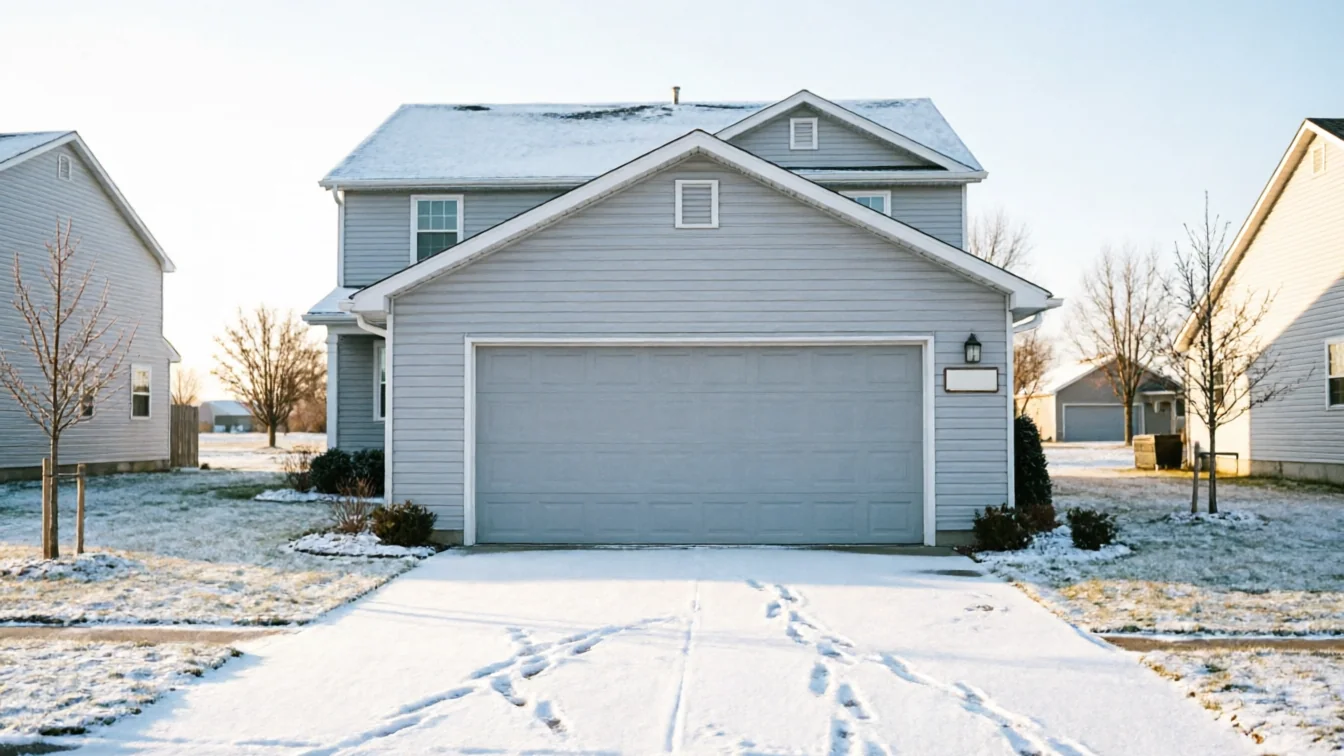
Most people figure a torsion spring breaks because it's old or because the door got used too much. Around here the bigger factor is the build date. Housing in this service area went up mostly between 1945 and 2008, with the median build year sitting around 1980, and most of the stock across the 39 named areas we cover dates to the 1980s and 90s. That generation of builder-grade torsion springs was sized for the loads of that era, not for forty-plus winters of flexing in an unheated Wisconsin garage. When a spring "just snaps," it's rarely a fluke. It's a thirty-to-forty-year-old coil that's been cycling through cold snaps every winter since it went in, and the steel finally gives at its weakest point during a stretch of hard cold. The spring on the other side of the same door, installed the same year, is usually not far behind it. Replacing one and ignoring its twin is how people end up making two calls instead of one.
The Situation
This is a working garage door trade area, not a single neighborhood. Across the roughly 95,421 households we serve, about 51,218 are owner-occupied houses - the kind with an attached or detached garage and a door that sees daily use. Median household income here runs around $85,980, which tracks with what we see on service calls: owners who maintain the house rather than let a door limp along, but who also want a straight answer before they spend money on a repair versus a full replacement. Calls come in from Appleton itself and from the towns around it - Kimberly, Little Chute, and Combined Locks a few miles out, Menasha, Fox Crossing, and Kaukauna a bit further, and smaller communities like Darboy, Greenville, Hortonville, and Seymour stretching out to fifteen and seventeen miles. The housing mix across that whole stretch skews to the 1980s and 90s, which means a lot of garages are running original or first-replacement hardware that's now old enough to be the reason for the call, not just the location of it.
What Local Conditions Do
This area sits in a cold-severe climate band, and that matters more for a garage door spring than most people expect. Steel contracts as temperatures drop, which tightens the wind on a torsion spring and raises the stress at the exact point where metal fatigue already concentrates. A spring that's been fine for years can go from "fine" to "snapped" in a single cold morning because the same coil that flexed easily in July is now stiffer and under more load in January. Lubricant on older springs and bearing plates also thickens in the cold, which adds drag the opener has to fight through on every cycle - another small stress that adds up over a severe winter. None of this is unique to one street or one house. It's a function of how cold this area gets, combined with how old a lot of the spring hardware already is from the 1980s-90s housing wave. The two facts compound each other: older steel, colder swings, more failures concentrated in the hard part of winter rather than spread evenly across the year.
The Seasonal Bit
The calls cluster. A cold stretch that drops temperatures hard tends to bring a run of broken-spring calls within a day or two of each other, because a lot of the hardware out there is the same age and under the same stress at the same time. That's useful to know if your door is making noise or feels heavy to lift by hand before the cold really sets in - it's worth dealing with before the spring picks the worst possible morning to go. The honest limitation: we don't keep every spring size on the truck for every door built in every decade. If your door uses an older or less common torsion spring size, there can be a short wait on the exact part rather than a same-day swap, especially during a stretch when several springs are failing at once across the area. We'll tell you straight if that's the case rather than put on a size that's close enough. A mismatched spring is its own kind of problem down the road.
Frequently asked questions
Why did my garage door spring break in the middle of winter and not some other time?
Cold tightens the wind on a torsion spring and stiffens old lubricant, both of which add stress right where metal fatigue already builds up over the years. A spring that's been fine through warmer months can reach its breaking point during a hard cold stretch, which is why failures cluster during the coldest weeks rather than spreading evenly through the year.
My house was built in the 1980s - is my spring original?
It's possible. A lot of the housing stock across this service area dates to the 1980s and 90s, and plenty of those garages are still running first-generation torsion springs. If yours has never been replaced, it's old enough that cold-weather failure is a real possibility, not a long shot.
Should I replace both springs on a double door, or just the broken one?
If both springs went in the same year, which is typical, the second one has seen the same cold cycles and the same wear as the one that broke. Replacing only the broken spring usually means a second call within a season or two. We'll look at the install date and condition of both before making that call with you.
Can a spring repair wait until spring?
A broken spring shouldn't wait - the opener and cables take on load they're not built for, and that's how a cable or opener goes next. A spring that's noisy or stiff but not broken can sometimes wait a short while, but a hard cold stretch is exactly when it's most likely to go.
Related garage door services in Appleton
More garage door guides
Book garage door service in Appleton
Call now or request a quote - tell us what the door is doing and where you are.