
Appleton, WI · Garage Door Service
Deciding Whether Your Appleton Garage Door Is Worth Fixing
Appleton homes built 1945-2008 carry a mix of door ages and hardware. Here's how to tell if yours is worth fixing or needs replacing before winter sets in.
- Repairs & new doors
- Springs & openers
- Serving 4 nearby communities
What Most People Get Wrong
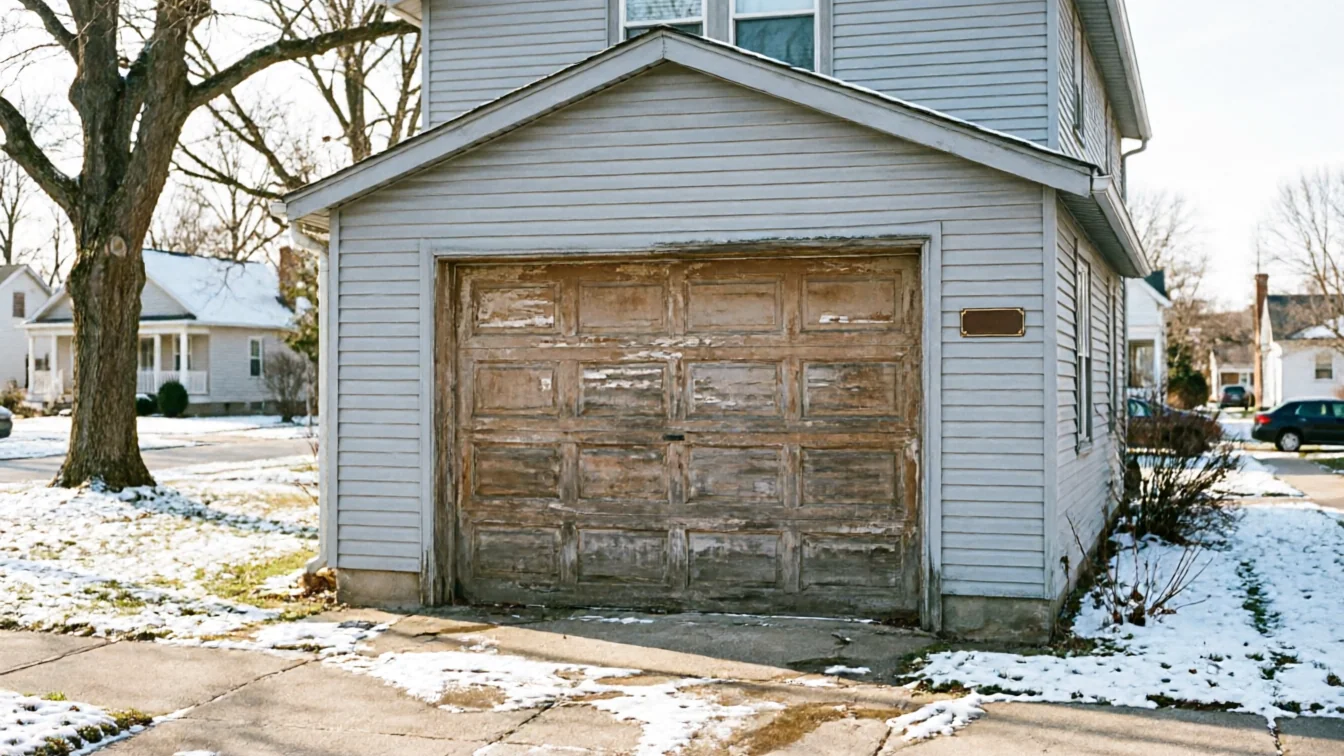
People often assume a garage door's age tells you everything about whether it's worth fixing. In the Appleton area, where houses went up anywhere from 1945 through 2008 with a median build year around 1980, that assumption falls apart fast. A door installed in a 1952 house isn't necessarily in worse shape than one in a 1995 subdivision home - a lot depends on whether the hardware was ever upgraded, and whether it's one of the original one-piece doors or a later sectional replacement. Across the 39 named areas that make up this market, the housing stock skews heavily toward that 1980s-90s build wave, which means most of what we see on service calls isn't the oldest door in town - it's a door from that middle stretch, often still on its original torsion spring and rollers because nobody's had a reason to touch it. The real question isn't how old the door is, but what's actually worn. A 40-year-old door with a steel frame that hasn't rusted and a track that's still square can be worth more money in repair than a 15-year-old door that was installed cheap and has been fighting a bent track since year three. Judge the door, not the decade.
The Situation
This service area covers roughly 95,421 households, about 51,218 of them owner-occupied houses, with median household income near $85,980. That matters for the fixing-versus-replacing math because the homes themselves run from postwar builds through early-2000s construction, and the doors on them reflect that same spread. We work out from Appleton toward Kimberly and Darboy a few miles southeast, Little Chute and Combined Locks a few miles further, and out through Kaukauna, Menasha, Fox Crossing, Freedom, Harrison, Greenville and the rest of the surrounding towns listed in our service footprint - some of those calls run 15 miles or more. The practical effect: a repair tech can't assume parts availability the way you could in a newer, single-era subdivision. A door original to a 1983 build in one of these older neighborhoods might use spring sizing or track hardware that newer stock doesn't carry, while a door from a 2005 build nearby is running current production parts. That spread is why we look at the actual door on the actual house rather than quoting a blanket age cutoff for repair versus replacement over the phone.
What Local Conditions Do
This area sits in a cold climate zone with severe winter conditions, and that does specific things to an older door that a mild climate never would. Steel contracts in deep cold, which tightens tolerances on tracks that are already slightly out of plumb from decades of use - a gap that's a minor rattle in July can bind a roller solid in January. Torsion springs lose a measurable amount of lifting power as temperature drops, so a spring that's already near the end of its cycle count is far more likely to snap on a sub-zero morning than in August. Weatherstripping on older doors, especially original vinyl on anything built before the mid-1990s, gets brittle and cracks in sustained cold, which lets in wind-driven snow at the bottom seal. None of that means an older door is doomed. It means the inspection has to include things a warm-climate tech wouldn't bother checking: spring cycle count, track alignment tolerance, and whether the bottom seal is still flexible at 10 degrees. A door that passes those checks is usually worth fixing. One that's already showing track binding before the cold hits is only going to get worse.
The Seasonal Bit
The repair-or-replace decision gets more urgent here right before the hard cold sets in, not during it. Once temperatures drop and stay down, a marginal spring or a slightly bent track stops being a someday problem and becomes a 6 a.m.-call problem, usually on the coldest morning of the stretch. If a door is already showing signs of wear going into fall, that's the window to deal with it while a tech can still work without the steel itself being a hazard to handle. One honest limitation: we don't carry parts for every discontinued torsion spring size or every obsolete opener model still running in some of the older homes out here, and on those jobs a full replacement ends up being faster and cheaper than hunting down a matching part. If your door was built in that 1980s-90s middle stretch common to this area, parts are usually still available and a repair makes sense. If it's an older one-piece door with hardware nobody's made in years, replacement is the more honest answer.
Frequently asked questions
How do I know if my garage door is too old to repair?
Age alone doesn't decide it - a door from the 1980s-90s stock common in this area is often still repairable if the track is square and the spring hasn't failed. What matters more is whether replacement hardware is still made for that model.
Does winter cold actually break garage doors here?
Yes. Cold tightens metal tolerances and saps spring lifting power, so a spring or track that's borderline in October often fails on the first hard cold snap. That's why we check cycle count and alignment before winter, not after a break.
Is it worth fixing a door from a house built in the 1950s?
Sometimes, sometimes not. Houses in this area run from 1945 through 2008, and a lot of 1950s doors have already had at least one hardware upgrade. If the frame and track are sound, repair can beat replacement even on an older door.
What if parts for my old opener or spring aren't made anymore?
That happens on some of the older one-piece doors still around here. When a part's discontinued, we won't pretend to track one down indefinitely - full replacement is usually the faster, cheaper call at that point.
Related garage door services in Appleton
More garage door guides
Book garage door service in Appleton
Call now or request a quote - tell us what the door is doing and where you are.