
Appleton, WI · Garage Door Service
Garage Door Repair for Harrison Homes
Garage door repair for Harrison, WI homes built mostly after 2000. We drive the 8 miles from Appleton and know the newer steel doors and openers this area runs.
- Repairs & new doors
- Springs & openers
- Serving 4 nearby communities
How to Book
Harrison sits about 8 miles from our shop in Appleton, close enough that a call here doesn't mean waiting half a day for a truck to clear the route. That drive matters for how we schedule: jobs on this side of the lake get grouped so a tech isn't making the trip for one call and doubling back for another. When you reach out, tell us what the door is doing - won't open, slams the last foot, opener clicks but nothing moves - and whether the house is newer construction, since most of Harrison was built well after 2000 and that changes what's likely wrong. We don't run a branch out here, we run from Appleton, so the more detail you give up front, the less guessing happens on your driveway.
We book by symptom, not by slot. If a spring has let go on a double door, that job jumps ahead of a noisy roller that's been noisy for a year. Either way, you'll know before the truck leaves Appleton roughly what we expect to find and what it runs, because we've already asked the right questions on the phone.
Time on the Job
Because Harrison's housing stock is younger than a lot of what we see closer to Appleton - the typical house here went up around 2001, not the 1980s median across the wider service area - the repairs tend to be more predictable. Newer torsion spring systems, factory-balanced doors, and openers built after the mid-90s safety-sensor requirement mean fewer surprises once the door's open and we're looking at it. A torsion spring swap on a standard double door usually runs under an hour once we're on site. A full opener swap takes longer, closer to ninety minutes with programming and sensor alignment.
What we can't shrink is the travel. The 8 miles each way is built into how the day is planned, not into what we charge once we're there - it just means your appointment window is set with that trip in mind, so we're not giving you a 20-minute arrival estimate we can't hold to from across town.
How We Fix It
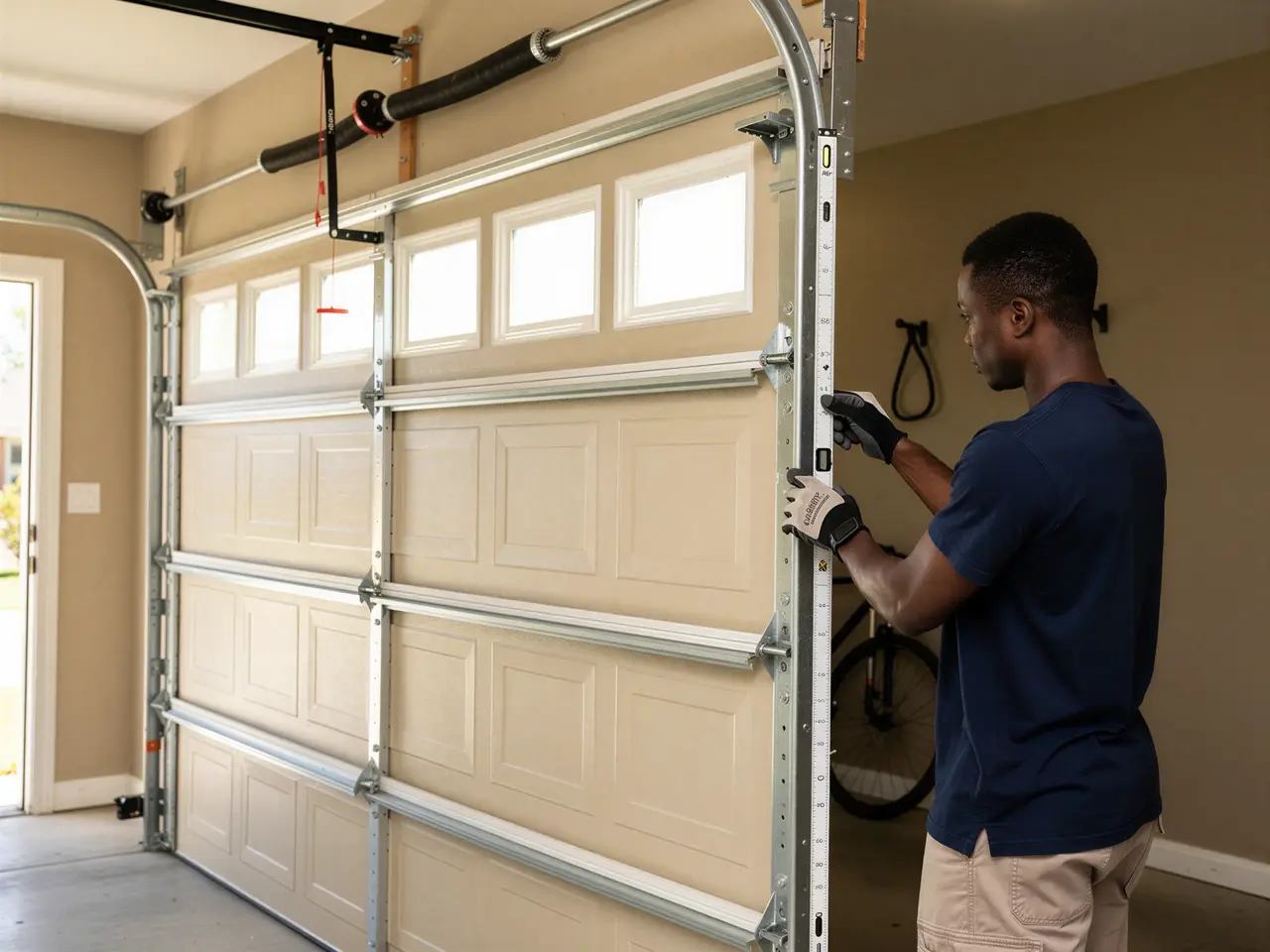
On a house built in the early 2000s, the door is almost always steel sectional on a torsion spring, lifted by a chain or belt opener with photo-eye sensors near the floor. That's a different repair than what you'd find on an older door with extension springs overhead and no safety reversal - the parts are more standardized, and we're not hunting for a discontinued bracket. We check the spring wind and cable tension first, then the track alignment, then the opener's force and travel settings, because on this newer stock the fault is more often a worn roller or a misaligned sensor than a structural problem with the door itself.
One honest limit: if a cable has frayed and jumped the drum, we don't reuse it. We replace it as a pair even if only one side failed, because a mismatched cable set under full spring tension isn't a repair we're willing to stand behind. That's a parts cost, not a labor shortcut, and we'll tell you before we start.
Can You Do This Yourself
A torsion spring is wound under enough tension to break a bone or worse - that's not a job for a Saturday with a borrowed winding bar, regardless of how new or old the house is. What you can handle yourself: lubricating rollers and hinges twice a year, checking that the photo-eye sensors are clean and aimed at each other, and testing the auto-reverse by laying a 2x4 flat under the door and making sure it kicks back up on contact. Winter in this part of Wisconsin is hard on door hardware - cold makes steel brittle and grease stiff, so a door that's merely sluggish in October can seize a cable or snap a spring by January.
If the opener runs but the door won't lift, or the door looks crooked in the track, stop operating it and call. Running a door with a broken strand or a bent track turns a parts repair into a full door replacement fast.
How It Shows Up
In Harrison, the call we get most isn't a door that won't move at all - it's one that's started hesitating partway up, or an opener that runs its full cycle but the door barely lifts a few inches before stalling. On newer torsion systems that's almost always the spring losing tension gradually rather than snapping outright, which is different from the sudden full break you'd expect on an older extension-spring setup. The other pattern we see on this side of the service area is sensor trouble - a photo-eye knocked out of alignment by a bike or a snowblower parked too close, which reads to the homeowner as 'the door won't close' when it's really just refusing to close on a false obstruction.
Cold is the other factor. A severe winter climate stiffens the spring steel and thickens old grease, so a door that was fine in September can start binding once temperatures drop, even with nothing broken yet.
Frequently asked questions
Do you have a shop or depot in Harrison?
No. We run out of Appleton and drive the roughly 8 miles to Harrison for each call. There's no local branch, so scheduling accounts for that travel rather than treating it as a separate stop.
Why does my newer garage door in Harrison still break?
Newer doesn't mean maintenance-free. Most Harrison homes were built after 2000 with standard torsion springs and sensor-equipped openers, and those parts wear on a schedule regardless of the house's age - usually spring fatigue, roller wear, or a sensor knocked out of alignment.
Is a torsion spring repair safe to put off?
Not for long. A spring under partial tension can still snap without warning, and a door running on one working spring puts uneven load on the opener and track. If you notice the door hesitating or sagging on one side, that's the time to call, not after it fully fails.
Book garage door service in Appleton
Call now or request a quote - tell us what the door is doing and where you are.