
Appleton, WI · Garage Door Service
Garage Door Maintenance for Harrison's Newer Housing Stock
Harrison homes were mostly built after 2001, so the failures are different from older Appleton stock. Here's what actually wears out and how we service it.
- Repairs & new doors
- Springs & openers
- Serving 4 nearby communities
How to Book
We run out of Appleton, about 8 miles from Harrison, so there's no branch office here and no same-town crew sitting idle waiting for a call. You book through us the same way any Appleton-area customer does, and a truck comes out to you. That's worth saying plainly because some sites imply a local depot they don't have - we don't have one in Harrison, and we'd rather tell you that than let you assume it.
What we need from you up front is simple: the door's approximate age, whether it's a single or double, and whether you've noticed anything specific - noise, drag, an opener that runs longer than it used to. Harrison's housing is young enough (median build year 2001) that most calls here are preventive rather than emergency, which means we can usually schedule rather than scramble. If something's actively stuck or off its track, say so, since that changes what we bring on the truck.
We serve the broader area including Harrison repair work and the full slate of services out of Appleton is covered on our main Appleton maintenance page.
Time on the Job
A standard maintenance visit on a door this age runs faster than the same visit on a house built in the 1970s or 80s, mostly because we're not fighting rust, warped track, or hardware that's been swapped out twice already. Harrison's median year built is 2001, which puts most doors in that window of galvanized steel track and factory-sealed bearings that were standard by then - fewer surprises, less disassembly to get at the parts that actually wear.
What takes the time isn't usually the door itself, it's winter. Appleton's whole service area sits in a cold-and-severe climate band, and that affects lubrication and weatherstripping on every door regardless of age. Grease that was fine in August gets stiff in January, and a door that swung smooth in fall can groan and bind by February if nobody's touched it. On a 2001-era door we're mostly checking that factory lube hasn't dried out over twenty-plus years, resetting spring tension if it's crept, and replacing bottom seal that's gone brittle from freeze-thaw cycling. That's a shorter visit than re-tracking an old door, but it's not nothing - budget for a real inspection, not a five-minute once-over.
How We Fix It
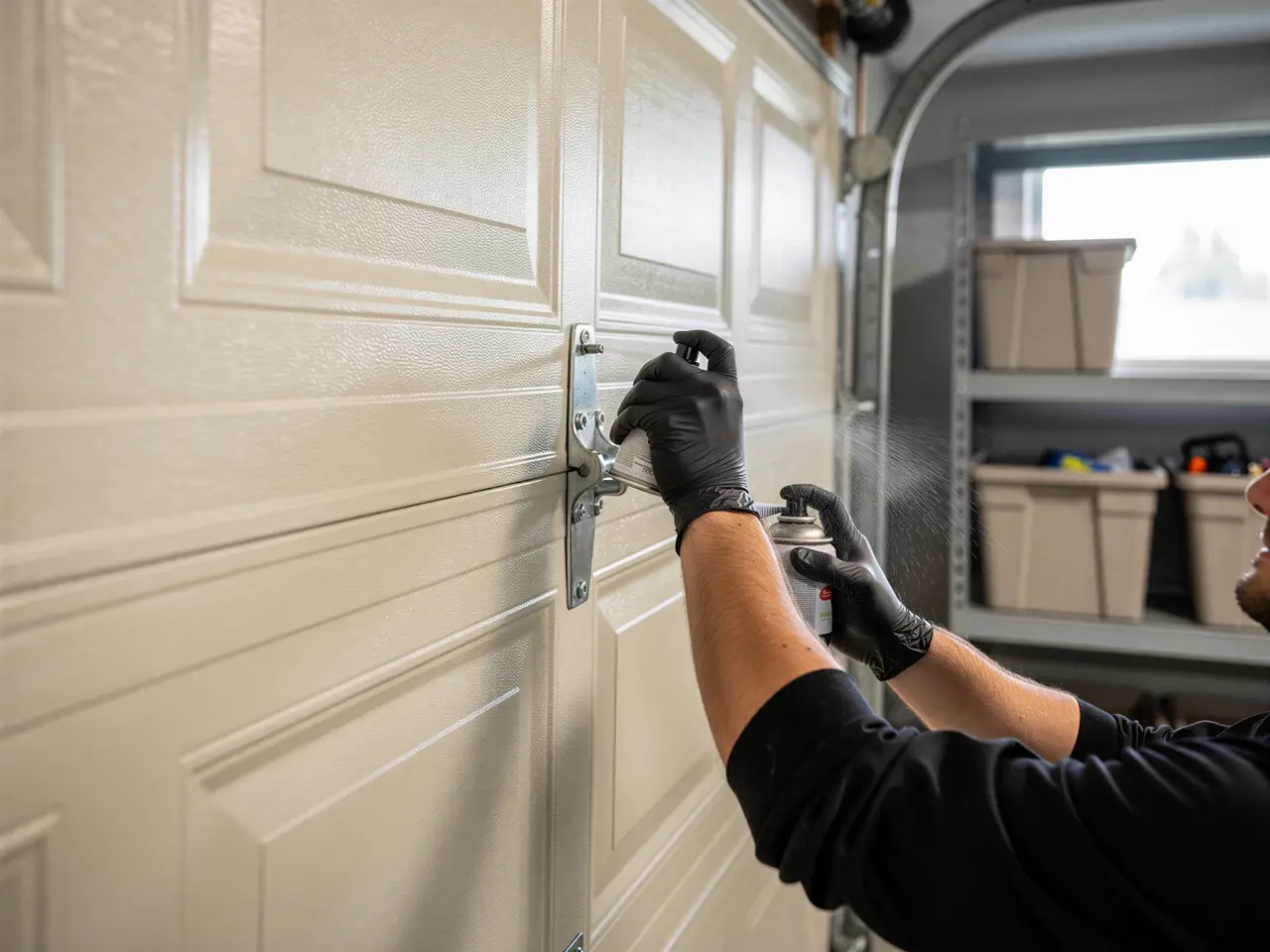
The fault that shows up most on Harrison's housing stock is dried-out factory lubrication on rollers and hinges - not broken parts, just parts that have gone twenty-plus years without fresh grease and are now grinding instead of rolling. We clean the old residue off the track and hardware, re-lubricate with a grease rated for cold, and check roller wear while we're in there. Nylon rollers from that era are usually fine at this age but worth inspecting since replacement is cheap compared to a seized track.
We also check spring tension. A door installed around 2001 is likely on its original torsion spring, and springs don't last forever regardless of how new the house is - cycle count matters more than calendar year. If a spring is near the end of its life, we'll tell you rather than just lubing around it.
Weatherstripping is the other common fix. Cold-climate freeze-thaw cracks bottom seal and side weatherstrip faster than people expect, and a gap there lets cold air and moisture into the garage all winter. We replace it when it's compressed or cracked, not before - there's no reason to swap seal that still has life in it just because it's due for a look.
Can You Do This Yourself
Some of this is genuinely DIY. You can visually check your bottom seal for cracking, listen for grinding at the rollers, and wipe down the track so dirt isn't grinding into the hardware. If your door is slamming shut faster than it used to, that's worth noticing yourself before it becomes a call.
What we'd tell you not to do is touch the torsion spring. That's true on a door built in 2001 just as much as one built in 1975 - the spring doesn't care how new the house is, and a spring under tension has hurt people who thought they could handle it with the garage door manual and a wrench. Leave that part to a call.
Lubrication is a middle case. You can do it yourself if you use the right product - not WD-40, which washes grease out rather than replacing it - but a lot of homeowners skip it for years because it's easy to forget, and that's exactly the fault we see most in this part of the service area.
How It Shows Up
On a Harrison-era door, the first sign is sound before it's function: a grind or squeal at the rollers that wasn't there a year ago, especially noticeable once temperatures drop and old grease stiffens. The door still opens and closes, which is why people put off calling - it's not broken yet, it's just getting louder and slower.
The second sign is the opener working harder than it should. If you notice the motor running longer, or the door hesitating partway up, that's often binding at the track or hardware rather than the opener itself failing. Since most homes here are on their original 2001-era hardware, that combination of sound plus sluggish travel is the pattern we see called in most.
What we don't see much of here, compared to older housing in the broader Appleton area, is warped wood track or rusted-through panel bottoms - that's an older-stock problem, not a Harrison-stock problem. The honest limitation: if a door here has gone that long without any lube or inspection, we may find a part close to failure on the visit, and that's a repair call, not a maintenance one.
Frequently asked questions
Is maintenance different for a newer house in Harrison versus an older one in Appleton?
Yes. Harrison's median year built is 2001, so most doors here are on galvanized track and factory-sealed hardware rather than the older wood track or worn steel you'd find on a 1960s or 70s house. The failures we catch are more about dried lubrication and spring fatigue than rust or warped track.
How often should I get my garage door serviced in Harrison?
We don't have a fixed interval specific to Harrison, but given the cold-and-severe climate band this whole area sits in, once a year before winter is a reasonable baseline for checking lubrication, spring tension, and weatherstripping before freeze-thaw cycles start working on the seals.
Do you have a crew based in Harrison?
No. We run out of Appleton, about 8 miles away, and send a truck out for every job in Harrison. There's no local branch here, just a short drive.
Can I lubricate my own garage door hardware?
You can, as long as you use a lubricant made for garage door hardware rather than a general degreaser like WD-40, which strips grease rather than replacing it. Springs are the one part we'd tell you to leave alone regardless of the door's age.
Book garage door service in Appleton
Call now or request a quote - tell us what the door is doing and where you are.