
Appleton, WI · Garage Door Service
Spring Repair for Harrison's Post-2000 Garage Doors
Harrison homes mostly went up after 2001, with factory torsion springs now hitting 20+ years old. We drive out from Appleton to fix the break, not just patch it.
- Repairs & new doors
- Springs & openers
- Serving 4 nearby communities
How to Book
Harrison sits about 8 miles from our shop in Appleton, and we run calls out there on the same truck as everywhere else in the area. When you call, tell us the door's age if you know it - for a lot of Harrison, that's going to land somewhere after 2001, since that's the median build year for homes here. That one number changes what spring we bring: newer torsion setups use different wire gauge and winding cones than the older doors we see closer to the Appleton core. We'll ask whether the door is a single 16-footer or a double stall, whether it's lifting at all or just sitting stuck, and whether you heard a bang. That tells us if it's a clean spring break or something that took the cable or a bottom bracket with it. We don't quote a price over the phone without seeing the door, because torsion jobs on wider two-car doors run more hardware than a single. If you can get a photo of the spring and the end bearing plate, send it - it saves a trip back to the truck for the right part size once we're there.
Time on the Job
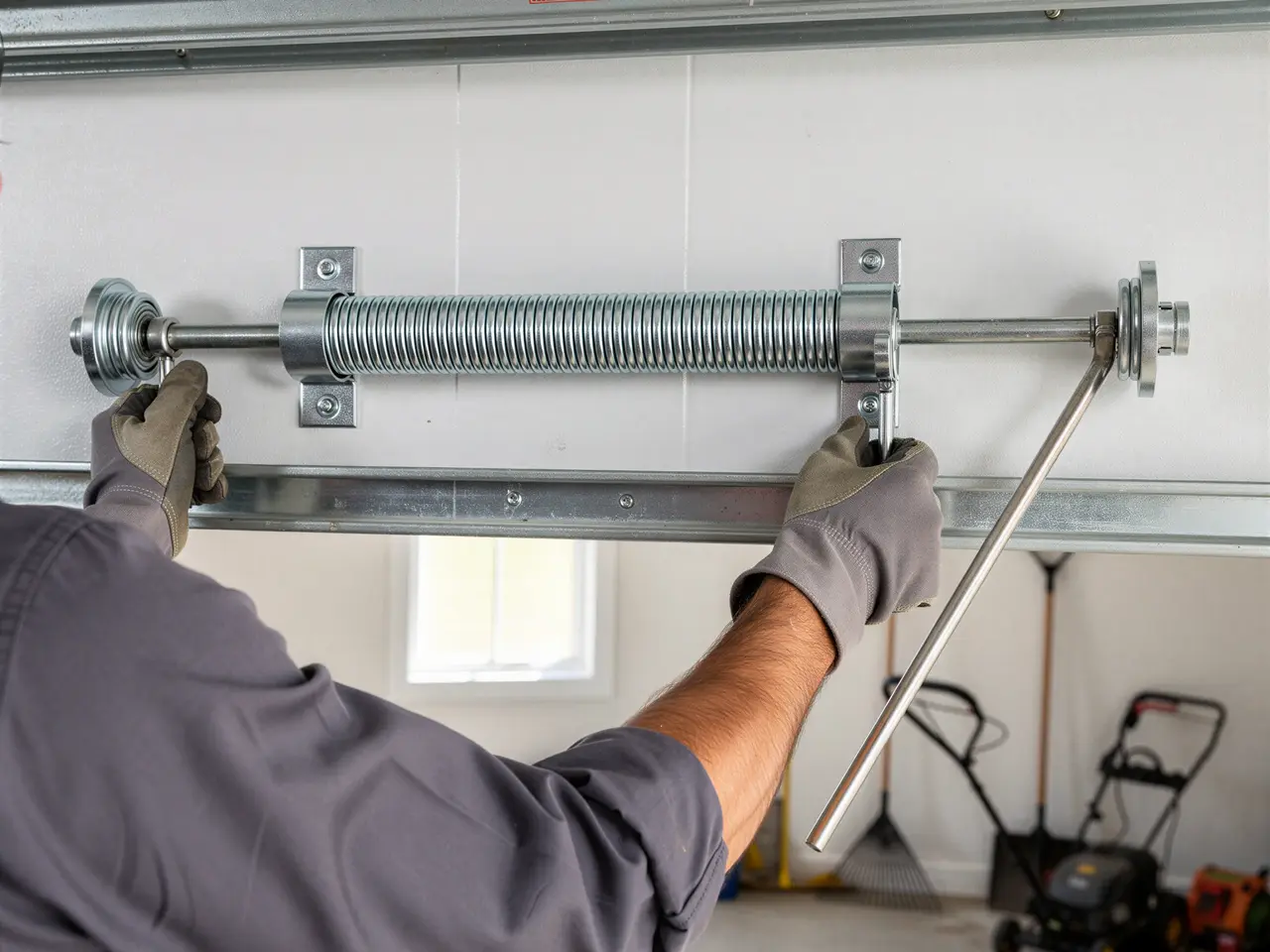
A straight torsion spring swap on a standard Harrison door, set up the way builders ran them in the early 2000s, is a controlled job - unwind the old spring, measure wire diameter and wind direction off the dead one, set the new one, and tension it off a winding bar in the opener's travel range. Where it runs long is when the broken spring took the cable with it, which happens more on doors that haven't been serviced since they were new. We're not going to rush tensioning to hit a number. A spring wound a quarter turn off spec either slams the door or won't lift it, and we'd rather take the extra ten minutes than come back out.
How We Fix It
We match wire gauge, coil length, and wind direction to the door and opener weight, not to whatever's sitting on the truck shelf. Most Harrison doors built in that 2001-and-later window came with standard torsion springs rated for the door's actual panel weight at the time, so unless someone's swapped the door or added insulation since, the replacement is usually a straight match. We check the cable drums, the bearing plates at each end of the shaft, and the center bracket while the spring's off, since that's the one time those parts are actually visible and loose. If a cable's frayed or a bearing's seized, we tell you before we button it back up - not as an upsell, just because it's right there and ignoring it means a second call. We set final tension so the door balances and holds at mid-travel on its own, which is the real test, not just that it goes up and down.
Can You Do This Yourself
A broken torsion spring is not a weekend fix with hand tools from the garage shelf. The spring is wound under several hundred pounds of tension, and the winding bars and clamps that make it safe aren't things most households own. We've seen the injuries that come from people trying it with a screwdriver and a stepladder, and they're not worth the money saved on a service call. What you can safely do yourself: watch for the warning signs - a door that's gotten noticeably heavier to lift by hand, a visible gap in the coil when you look at the spring above the door, or a loud bang from the garage. Call before it fully lets go rather than after, since a controlled appointment beats a door stuck shut on a cold morning.
How It Shows Up
Winters here are the kind that stiffen lubricant and shrink metal, which is hard on any torsion spring regardless of age, but it speeds up failure on springs that are already fatigued. For Harrison, with most homes going up after 2001, we're starting to see the first wave of original factory springs reach the end of their cycle life - these doors are old enough now that the springs installed at construction are simply worn out, not damaged by anything specific. The failure usually shows up the same way: a loud crack from the garage, then the door feels like dead weight the next time someone tries to lift it by hand or the opener strains and reverses. If your door is in that original-build range and nobody's touched the spring since the house was new, that's the most likely cause, not the opener and not the track.
Frequently asked questions
How old does a torsion spring usually get before it breaks?
Most torsion springs are rated for a number of open-close cycles rather than a calendar age, but houses in Harrison built in the early 2000s are now old enough that original factory springs are reaching that limit. If yours has never been replaced, age is the most likely reason it broke, not misuse.
Do you carry spring sizes for newer doors like the ones in Harrison?
We bring stock sized to match standard torsion setups, including the wire gauge common on doors built in the early 2000s. We confirm the exact size against the broken spring and the door's panel weight on site before installing, rather than guessing from the door's age alone.
Can I just replace one spring if I have a double door with two?
You can, but we don't recommend it. If one spring broke from fatigue, the other is usually close behind on the same age and cycle count. Replacing both at once means one visit instead of two and a door that lifts evenly on both sides.
Is it worth replacing the opener at the same time as the spring?
Not usually, if the opener is running fine. A tired spring makes any opener work harder and can mask whether the opener itself still has life left, so we check that after the new spring is tensioned rather than guessing beforehand.
Book garage door service in Appleton
Call now or request a quote - tell us what the door is doing and where you are.